
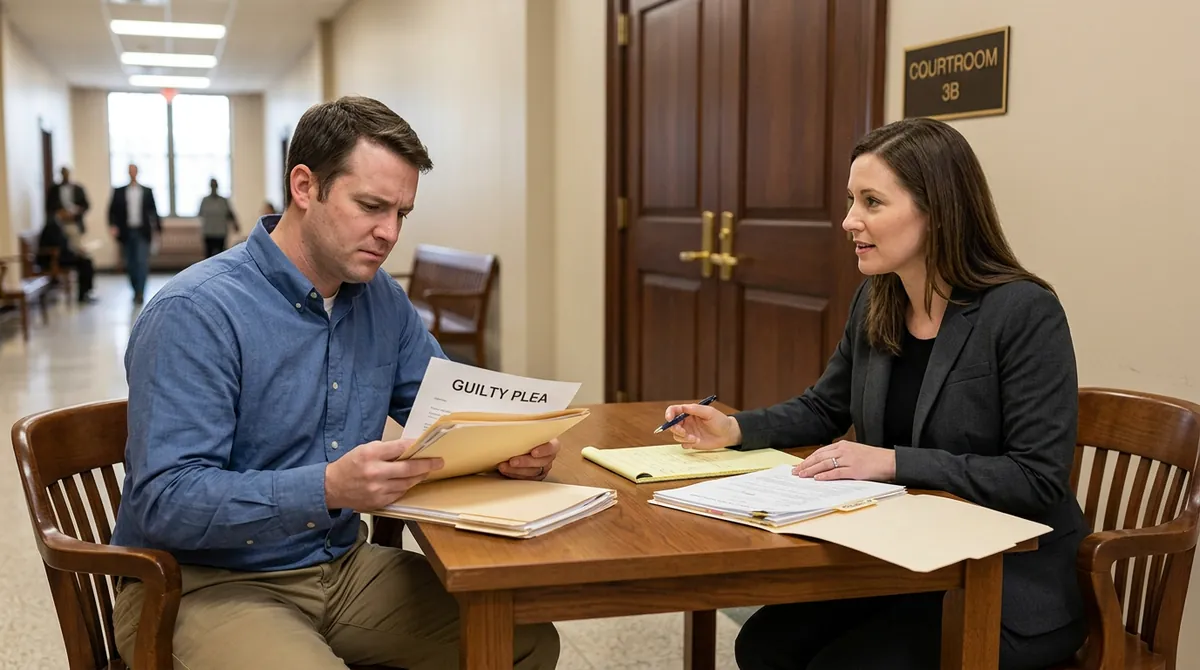
Every week, people walk into Tennessee courtrooms and plead guilty to criminal charges without an attorney. Sometimes they do it because they cannot afford a lawyer and don't know they can request a public defender. Sometimes they do it because they think the charge is minor and it will just be a fine. Sometimes they do it because a police officer or a clerk told them it would be "easier" to just take the deal.
Almost always, they regret it.
As a former prosecutor for the 16th Judicial District — the court district covering Rutherford and Cannon Counties — I have watched this happen. And as a defense attorney, I now spend part of my practice helping people deal with the consequences of guilty pleas they did not fully understand when they entered them.
Here is what you need to know before you make this decision.
The Pressure to Plead Guilty Is Real — and Intentional
The criminal justice system handles an enormous volume of cases. Prosecutors, courts, and even public defenders are stretched thin. The path of least resistance for everyone involved — except you — is often a quick guilty plea.
You may hear things like:
- "This is a good deal. Take it while it's on the table."
- "If you fight it, the judge will go harder on you."
- "It's just a misdemeanor. It's basically nothing."
- "You'll avoid jail time if you just plead guilty now."
Some of these statements may be true in your specific case. Some may be exaggerated, misleading, or flatly wrong. The problem is: how would you know, without an attorney who has reviewed the facts and the law?
You would not perform surgery on yourself because a hospital was busy. You should not make a decision with potentially lifelong legal consequences without legal advice.
"It's Just a Misdemeanor" Is Not the Whole Story
The most dangerous misconception in criminal law is that a misdemeanor conviction is no big deal. It is.
A Class A misdemeanor in Tennessee carries up to 11 months and 29 days in jail and fines up to $2,500. But the sentence itself is often the least consequential part of the conviction. Here is what a misdemeanor conviction can actually cost you:
Employment: Background checks are standard. Many employers screen for any criminal conviction, not just felonies. Security clearances, government employment, healthcare jobs, school positions, and financial services jobs are routinely denied to applicants with criminal records — even misdemeanors.
Professional licenses: Tennessee licensing boards for nurses, teachers, real estate agents, contractors, and many other professions conduct character reviews. A conviction — especially one involving violence, dishonesty, or substance abuse — can result in license denial, probation, or revocation.
Firearm rights: A domestic assault conviction under federal law (the Lautenberg Amendment) prohibits firearm possession — permanently — regardless of whether the conviction is a felony or a misdemeanor. This surprises many people. A plea to a misdemeanor domestic assault charge can mean the permanent loss of your Second Amendment rights.
Housing: Landlords run criminal background checks. Many will decline applicants with any criminal history.
Immigration: If you are not a U.S. citizen, a criminal conviction — including a misdemeanor — can have immigration consequences including deportation, denial of naturalization, and inadmissibility. This is true even for lawful permanent residents.
Future criminal cases: A prior conviction can be used to enhance future charges and sentences. A prior DUI, for example, increases the mandatory minimums for a subsequent DUI charge. A prior misdemeanor can affect bail decisions, sentencing recommendations, and diversion eligibility.
What Happens When You Plead Guilty Without an Attorney
When you enter a guilty plea, you are waiving multiple constitutional rights:
- The right to a trial by jury
- The right to confront and cross-examine witnesses
- The right to present evidence in your defense
- The privilege against self-incrimination
Courts are required to ensure that a waiver of these rights is knowing and voluntary. A judge will typically ask you a series of questions to confirm that you understand what you are giving up.
But here is the reality: a brief colloquy in a busy General Sessions courtroom does not fully substitute for the advice of an attorney who has reviewed your specific case.
Without an attorney, you may not know:
- Whether the stop, search, or arrest was lawful — if it was not, evidence may be suppressible
- Whether the State's evidence is actually sufficient to convict you at trial
- Whether you are eligible for judicial diversion, which could result in the charge being dismissed and expunged after a probationary period
- Whether the guilty plea will trigger consequences you did not anticipate — like the loss of a professional license or immigration consequences
- Whether a better deal was available than the one you were offered
The Reality: Many Cases Are Defensible
One of the most important things I want you to understand is this: many criminal charges that look open-and-shut are not.
DUI cases can be beaten because of improper traffic stops, faulty breathalyzer equipment, or improperly administered field sobriety tests. Drug charges can be dismissed because of unlawful searches and seizures. Assault charges can be defeated with self-defense evidence or witness credibility challenges. Theft charges can fall apart when intent cannot be proven.
As a former prosecutor, I know that the cases that look strongest on the surface are often the ones with the most vulnerabilities underneath. I also know that prosecutors are more willing to offer reasonable deals — or drop charges entirely — when they know they are facing a prepared, experienced defense attorney.
The offer you receive when you walk in unrepresented is almost never the best offer available.
If You Cannot Afford a Private Attorney
You have a constitutional right to an attorney under the Sixth Amendment. If you cannot afford one and you are facing potential jail time, you can request a public defender. The court will determine whether you qualify based on your income.
Public defenders are lawyers. They know the law. In many jurisdictions, they know the local judges and prosecutors well. If you qualify for a public defender, use one.
However, public defenders are frequently overloaded with cases. Many handle hundreds of active clients simultaneously. If your case is complex, the stakes are high, or you have concerns about the time and attention your case requires, consulting with a private criminal defense attorney is worth doing — even if it is just for a second opinion before you make a plea decision.
What You Should Do Instead of Pleading Guilty Right Away
Step 1: Say nothing and request an attorney. If you are arrested or questioned, invoke your right to remain silent and ask for an attorney. Do not explain yourself to police. Everything you say can be used against you.
Step 2: Contact a defense attorney before your arraignment. Your arraignment — the hearing where you enter your initial plea — is where the process begins. Entering a "not guilty" plea at arraignment does not mean you are going to trial. It simply preserves your options while your attorney reviews the case.
Step 3: Get a full case review. A defense attorney should review: the police report, any video evidence, the charge details, your criminal history, and the State's likely evidence. That review tells you what you are actually facing — not what the prosecution wants you to think you are facing.
Step 4: Make an informed decision. After a full review, you may decide that a guilty plea is the right outcome — but to a reduced charge, with a better sentence, or with a diversion agreement that leads to expungement. Or you may decide to fight. Either way, you will be making that decision with full information.
Facing Criminal Charges in Murfreesboro or Middle Tennessee?
Do not plead guilty to save time. The time you save today may cost you years of consequences. Contact Quinn Rodriguez Law PLLC for a free, confidential consultation before you make any decision about your case.
As a former police officer and former prosecutor, I know how these cases are built — and I know how to challenge them. I represent clients throughout Rutherford County, Williamson County, Wilson County, and all of Middle Tennessee.
Call (615) 546-5551 or contact us through our online form. We respond fast — because your situation can't wait.
This article is for general informational purposes only and does not constitute legal advice. Every case is different. Contact an attorney to discuss the specific facts of your situation.